A very common question is whether it is legitimate to use Likert scale data in parametric statistical procedures that 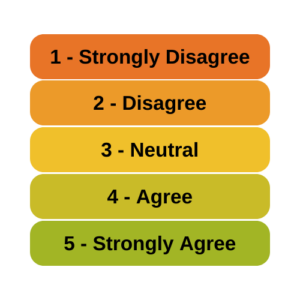 require interval data, such as Linear Regression, ANOVA, and Factor Analysis.
A typical Likert scale item has 5 to 11 points that indicate the degree of something. For example, it could measure agreement with a statement, such as 1=Strongly Disagree to 5=Strongly Agree. It can be a 1 to 5 scale, 0 to 10, etc. (more…)
 Multinomial logistic regression is an important type of categorical data analysis. Specifically, it’s used when your response variable is nominal: more than two categories and not ordered.
(more…)
 Centering variables is common practice in some areas, and rarely seen in others. That being the case, it isn’t always clear what are the reasons for centering variables.
 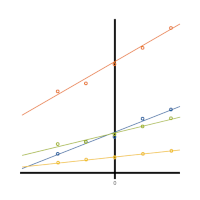 Is it only a matter of preference, or does centering variables help with analysis and interpretation? (more…)
 Is it really ok to treat Likert items as continuous?
  And can you just decide to combine Likert items to make a scale? Likert-type data is extremely common—and so are questions like these about how to analyze it appropriately. (more…)
When is it important to use adjusted R-squared instead of R-squared?
R², the Coefficient of Determination, is one of the most useful and intuitive statistics we have in linear regression.
It tells you how well the model predicts the outcome and has some nice properties. But it also has one big drawback.
(more…)
What are the assumptions of linear models? If you compare two lists of assumptions, most of the time they’re not the same.
(more…)

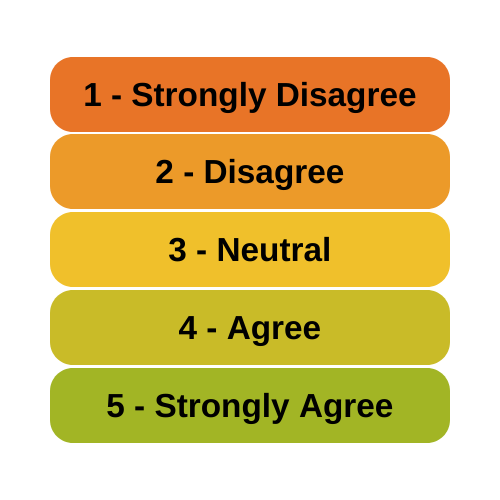 require interval data, such as Linear Regression, ANOVA, and Factor Analysis.