
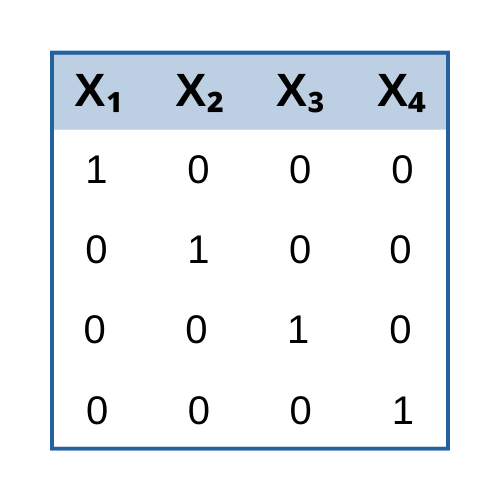
new blog post: Member Training: Dummy and Effect Coding
Previous Posts
One of Stata’s incredibly useful abilities is to temporarily store calculations from commands. Why is this so useful?
In the webinar we will travel beyond “statistical significance” to “practical significance”, “how big of a difference” rather than “is there a difference”.
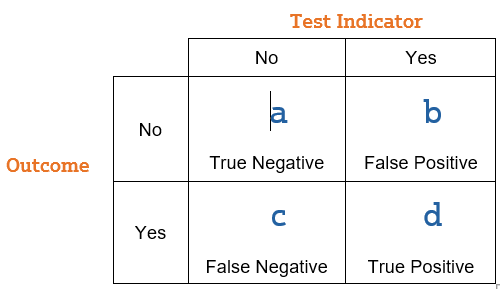
A perfectly accurate test would put every transaction into boxes a and d. Thieves are stopped but customers are not. A test that is so bad it's worthless would have a lot of b's (angry customers without groceries) and c's (happy thieves with groceries) and possibly both.
In this webinar, we will review the interpretation of p-values and see an alternative approach based on Bayesian data analysis.
Many of the common effect size statistics, like eta-squared and Cohen's d, can't be calculated in a logistic regression model. So now what do you use?
One of the big assumptions of linear models is that the residuals are normally distributed. This doesn't mean that Y, the response variable, has to also be normally distributed, but it does have to be continuous, unbounded and measured on an interval or ratio scale. Unfortunately, categorical response variables are none of these.
Why is it we can model non-linear effects in linear regression? What the heck does it mean for a model to be “linear in the parameters?” In this webinar we will explore a number of ways of using a linear regression to model a non-linear effect between X and Y.
Last time we created two variables and used the lm() command to perform a least squares regression on them, and diagnosing our regression using the plot() command..
Last time we created two variables and used the lm() command to perform a least squares regression on them, treating one of them as the dependent variable and the other as the independent variable. Here they are again..
Today let’s re-create two variables and see how to plot them and include a regression line. We take height to be a variable that describes the heights (in cm) of ten people.
 stat skill-building compass