
new blog post: Member Training: Dummy and Effect Coding
Previous Posts
In Part 12, let’s see how to create histograms in R. Let’s create a simple histogram using the hist() command, which is easy to use, but actually quite sophisticated.
Multicollinearity isn’t an assumption of regression models; it’s a data issue. And while it can be seriously problematic, more often it’s just a nuisance.
You may have never heard of listwise deletion for missing data, but you’ve probably used it. Listwise deletion means that any individual in a data set is deleted from an analysis if they’re missing data on any variable in the analysis. Although the simplicity of it is a major advantage, it causes big problems in many missing data situations.
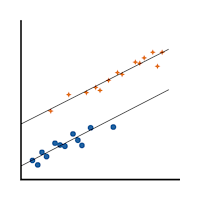
Including Z in the model often leads to the relationship between X and Y becoming more significant because Z has explained some of the otherwise unexplained variance in Y. An example of this kind of covariate is when an experimental manipulation (X) on response time (Y) only becomes significant when we control for finger dexterity levels (Z).
In this webinar, we’ll discuss many of the issues involved in measuring time, including censoring, and introduce one specific type of event history model: the logistic model for discrete time events.
Someone recently asked me if they need to learn R. In responding, it struck me that this is another way that learning a stat package is like learning a new language. The metaphor is extremely helpful for deciding when and how to learn a new stat package, and to keep you going when the going gets rough.
Effect Size Statistics are all the rage. Journal editors want to see them in every results section. You need them for performing sample size estimates. (And editors want those too). But statistical software doesn’t always give us the effect sizes we need. In this webinar, we will go over: The difference between standardized and unstandardized […]
In Part 11, let’s see how to create bar charts in R. Let’s create a simple bar chart using the barplot() command, which is easy to use. First, we set up a vector of numbers. Then we count them using the table() command, and then we plot them. The table() command creates a simple table of counts of the elements in a data set.
Understanding moderation is one of those topics in statistics that is so much harder than it needs to be. Here are three suggestions to make it just a little easier. 1. Realize that moderation just means an interaction I have spoken with a number of researchers who are surprised to learn that moderation is just […]
Do I really need to learn R? Someone asked me this recently. Many R advocates would absolutely say yes to everyone who asks. I don't. (I actually gave her a pretty long answer, summarized here).
 stat skill-building compass